

Crop insurance market seen reaching $155.18 billion by 2035
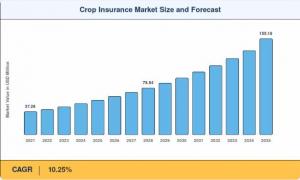
A new market report says the global crop insurance market is expected to grow from $55.93 billion in 2025 to $155.18 billion by 2035, driven by digital underwriting, IoT-linked field monitoring and climate-risk management tools. North America leads today, while Asia-Pacific is projected to grow fastest over the next decade.
Why it matters: - Crop insurance is shifting from basic yield protection to digital, data-driven climate-risk coverage. - The market’s projected 10.25% CAGR through 2035 signals strong demand for financial protection as weather volatility and farm losses become harder to absorb. - Better underwriting and faster claims handling could lower risk for farmers, insurers and reinsurers.
What happened: - Market Research Future projected the global crop insurance market will rise from $55.93 billion in 2025 to $62.15 billion in 2026. - The report expects the market to reach $155.18 billion by 2035. - The forecast implies a 10.25% CAGR across the period. - The report was published June 9, 2026. - Market Research Future offers a full report and a sample copy.
The details: - The report says growth is being driven by predictive risk modeling, IoT connectivity, real-time weather monitoring and smart asset tracking across farms. - Crop insurers are increasingly using simulation tools to model climate events, price policies and estimate drought or flood risk. - Telematics and remote sensing are being used to track soil moisture, weather alerts, vegetative indices and claim anomalies. - Digital policy platforms are adding dashboards, 3D terrain views and automated index-based triggers. - By coverage type, the report highlights multi-peril crop insurance, revenue protection insurance and yield protection insurance. - By technology and coverage model, the report includes telematics and IoT-enabled policies, simulation-driven AI and web or app-integrated products. - By premium structure, the report highlights subsidized government programs, commercial direct sales and AgTech subscription bundles. - North America holds the largest market share, supported by the federal crop insurance system and precision agriculture adoption. - Asia-Pacific is expected to grow fastest, helped by government subsidies and rising climate-risk awareness in India and China.
Between the lines: - The report points to a broader shift from paper-based claims toward always-on risk management tied to field data. - Index and parametric products could expand coverage in markets where traditional loss adjustment is slow or costly. - Government subsidies remain a major demand catalyst because they cut out-of-pocket costs for smallholders. - The company identifies basis risk as a key underwriting challenge for index-based products.
What’s next: - The report expects more integration between satellite imagery, cloud systems and decentralized IoT tools. - Insurers are likely to push more predictive warnings to farmers before weather events hit. - The market’s next growth phase appears tied to faster digital claims, broader subsidy support and more precise farm-level data.
The bottom line: - Crop insurance is evolving into a connected climate-risk platform, and the market forecast suggests that shift has years of growth ahead.
Disclaimer: This article was produced by AGP Wire with the assistance of artificial intelligence based on original source content and has been refined to improve clarity, structure, and readability. This content is provided on an “as is” basis. While care has been taken in its preparation, it may contain inaccuracies or omissions, and readers should consult the original source and independently verify key information where appropriate. This content is for informational purposes only and does not constitute legal, financial, investment, or other professional advice.
Sign up for:
Insurance Press Releases
The daily local news briefing you can trust. Every day. Subscribe now.
Check Your Email!
We sent a one-time activation link to: .
Confirm it's you by clicking the email link.
If the email is not in your inbox, check spam or try again.
Welcome back!
is already signed up. Check your inbox for updates.